流星之绊
Record-setting Typhoon Dolphin sweeps northward, triggering alerts across eastern and central China, suspension of traffic_我的网站

一 |
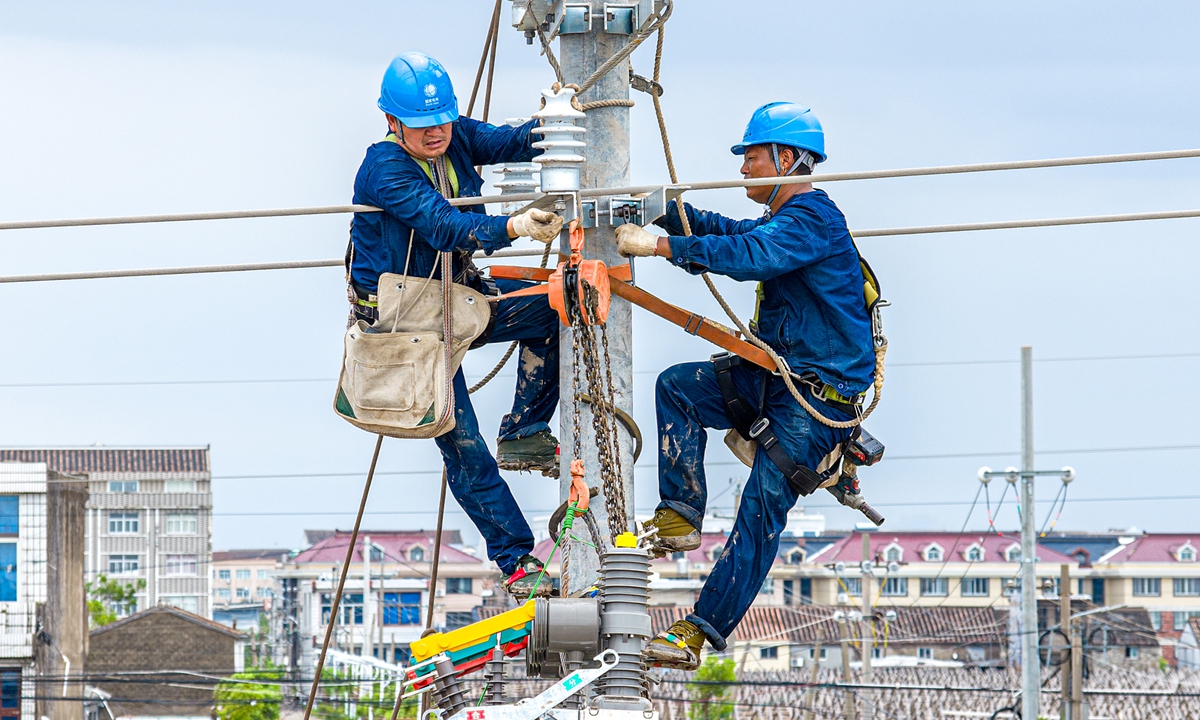
Emergency repair workers from the State Grid city power supply company replace porcelain insulators in Wenling, East China's Zhejiang Province on August 10, 2026, to ensure the supply of power after Typhoon Dolphin made landfall. Photo: VCG
After Typhoon Dolphin, one of the most powerful tropical cyclones to hit China this year, made landfall twice in East China's Zhejiang Province on Sunday, bringing torrential rain and strong winds, it weakened into a tropical storm by Monday morning before moving inland.
The typhoon traveled more than 6,000 kilometers before landfall, lasted more than three times as long as a typical typhoon and set a record as the eastern-most typhoon to make landfall in China. It is expected to continue moving northwestward with its extensive cloud system covering much of East China, bringing strong winds and heavy rain to more than a dozen provinces and regions. Extreme rainfall is expected not only near the landfall spot but also along its northward path, chinanews.com reported on Monday.
Affected by Typhoon Dolphin, ferry services along the Yangtze River have been suspended, and traffic restrictions have been imposed along the entire Nanjing section of the river. All 64 ferry services have been suspended, with crews reinforcing mooring lines and maritime authorities deploying additional personnel on standby.
Traffic controls are in effect along the entire Nanjing section of the Yangtze River, with all vessel operations suspended. More than 1,000 vessels and over 7,000 crew members are sheltering, while emergency boats remain on standby for possible incidents. More than 100 high-speed trains at Nanjing South Railway Station have been suspended, while Metro Line S9 is also out of service. Traffic and urban management crews are working to drain accumulated water. Nanjing has also closed outdoor and water-based entertainment facilities at all rated tourist sites and suspended outdoor cultural and tourism activities amid the typhoon.
The Ministry of Finance and the Ministry of Emergency Management urgently allocated 180 million yuan ($26.74 million) in central government disaster relief funds on Monday. Of this amount, 120 million yuan was allocated to support Jiangsu, Zhejiang, Anhui, Fujian and Jiangxi in carrying out emergency flood and typhoon response and disaster relief efforts. The funds will support search and rescue,the relocation of affected residents, emergency measures to eliminate risks and hazards, the investigation and treatment of potential secondary disaster hazards, and repair to damaged homes.
The National Development and Reform Commission urgently allocated 200 million yuan to support Zhejiang in post-typhoon emergency restoration and recovery, focusing on damaged infrastructure like roads and water conservancy, as well as public services such as schools and hospitals, per CCTV News.
Several government departments also jointly activated a Level IV national disaster relief emergency response on Monday after Typhoon Dolphin severely affected Zhejiang. A disaster relief team was sent to the province to assess damage and assist with evacuations, relief efforts and basic necessities, according to CCTV.
Ma Jun, director of the Institute of Public and Environmental Affairs, told the Global Times that as the typhoon moves farther inland and northward, a much broader area in northern China also needs to prepare for heavy rainfall as the typhoon is carrying a significant amount of moisture and is capable of producing intense precipitation.
The typhoon's impacts will extend into central China, with Henan and Shandong potentially seeing significant effects. Later, the storm could even affect the Beijing-Tianjin-Hebei region, Ma said.
According to the National Meteorological Center (NMC), persistent heavy rainfall is expected across regions including Hubei, Henan and Hebei with torrential rain possible in some areas over the next three days. After Thursday, as the typhoon's remnants move northward and interact with cold air, significant rainfall is expected to continue in Beijing, Tianjin, Hebei and Liaoning, chinanews.com reported on Monday.
A Level IV flood-control emergency response has been activated on Monday for Hubei and Shandong, Hebei and Henan provinces due to prospects of typhoon impacts, CCTV reported.
The Ministry of Emergency Management urged affected regions to strengthen geological disaster prevention, clarify responsibilities, enhance interagency coordination and information sharing, and closely monitor rainfall, flooding and geological hazards, according to Xinhua.
Beijing also issued multiple orange alerts for heavy rain, flash flood hazards and urban flooding on Monday. Several districts subsequently issued red alerts for torrential rain. Beijing plans to activate a Level II flood-control emergency response across the city on Tuesday morning, CCTV reported.
。 The year 2026 marks the 70th anniversary of the establishment of diplomatic relations between China and Egypt, as well as the 70th anniversary of diplomatic relations between China and Arab states.
A recent survey on "How Chinese people view Egypt" conducted by the Global Times Institute found that Egypt's ancient civilization has left a deep impression on the Chinese public.
Most respondents view Egypt as a friendly country or strategic partner, hold optimistic expectations for the future development of China-Egypt relations and strongly support deeper cooperation. Chinese and Egyptian experts said that Chinese people's favorable impressions of Egypt are rooted in both historical and current factors.
The mutual respect and appreciation between China and Egypt for each other's civilizations and cultures, as well as practical cooperation between the two countries in various fields, have promoted the development of China-Egypt relations and shaped positive views of Egypt among Chinese people.
The survey was conducted from July 16 to 28 among ordinary people aged 18 to 69 across 31 provincial-level regions.
A total of 1,845 valid questionnaires were collected, with sample support provided by professional market research company DATA 100.
The data was weighted based on the gender and age structure of internet users in the 57th Statistical Report on China's Internet Development released by the China Internet Network Information Center in February 2026.
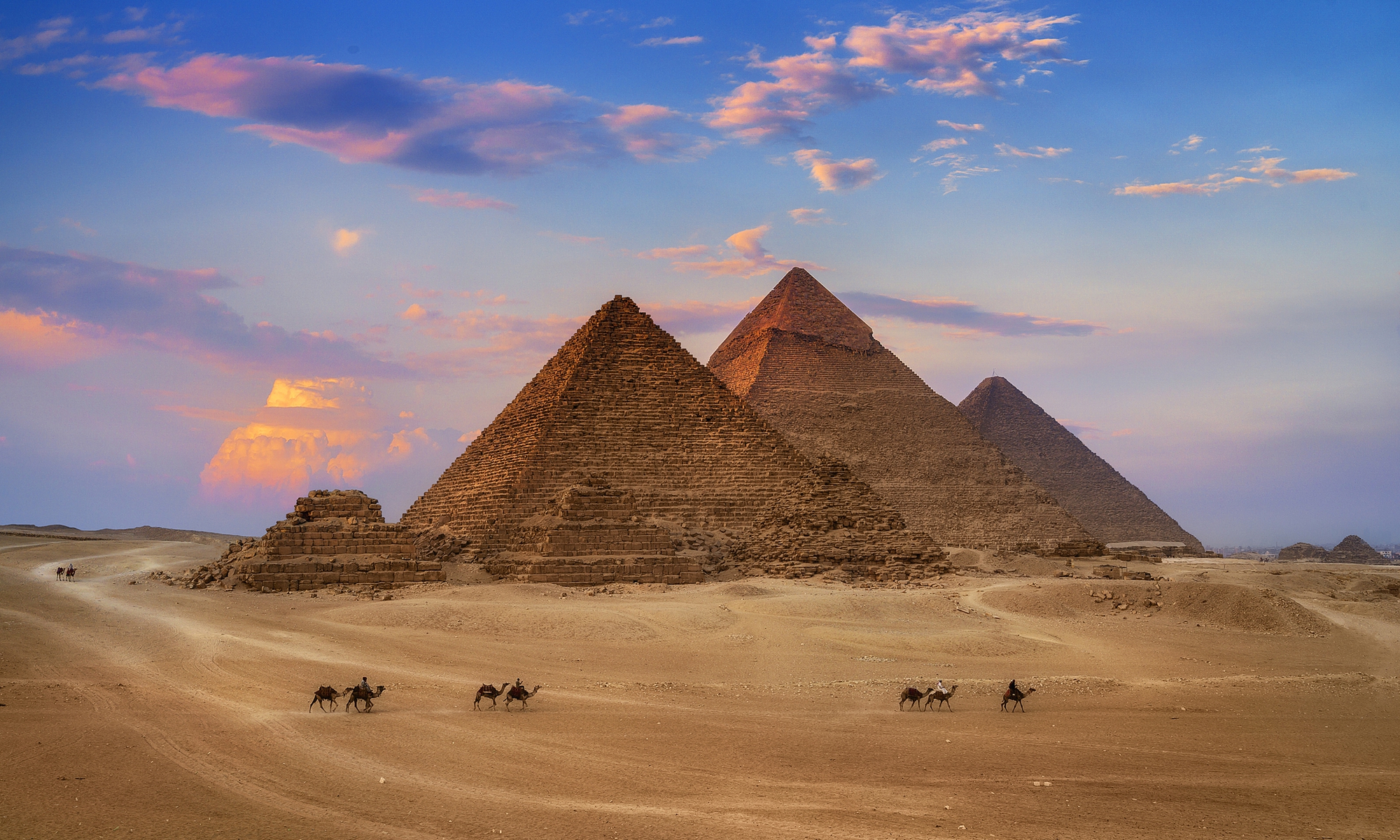
The landmarks in Egypt Photos: VCG
Impressive civilization
China-Egypt exchanges and cooperation have been active in multiple fields. In recent years, the two countries have held a variety of events, including cultural weeks, film festivals, cultural relic exhibitions and photo exhibitions, expanding people-to-people and cultural exchanges that have been warmly welcomed by people from both countries.
Survey data shows that 85 percent of Chinese respondents have some degree of understanding of Egypt, including about 40 percent who are "very familiar" or "relatively familiar" with Egypt, while more than 40 percent have some basic knowledge of the country. The Global Times Institute conducted an in-depth study of the 1,845 respondents who had knowledge of Egypt.
China and Egypt are both among the world's four ancient civilizations. Egypt's ancient civilization heritage has left the deepest impression on Chinese respondents. When mentioning Egypt, 66 percent of respondents first thought of iconic elements of ancient civilization such as the pyramids, pharaohs, mummies and the Sphinx, while 39 percent associated Egypt with its status as an ancient civilization. Some respondents also thought of natural landscapes such as the Nile River (30 percent), the Suez Canal (20 percent), and the Red Sea/the Mediterranean Sea (8 percent).
Egypt is not only a member of the African Union (AU), but also a founding member of the UN and holds other important international identities. In 2024, it officially joined the BRICS cooperation mechanism.
Regarding Egypt's multiple international roles, nearly 80 percent of respondents were able to correctly identify at least one of them. Among these, respondents showed relatively high awareness of Egypt's role as a core leading country of the League of Arab States, a BRICS member and a major AU country, with recognition rates all exceeding 30 percent.
In addition, more than 20 percent of respondents recognized Egypt's identity as a full member of the Organization of Islamic Cooperation and as a member of the Global South. As a founding member of the Arab League, Egypt has in recent years actively participated in ceasefire mediation, humanitarian aid coordination and dialogue efforts on Middle East hotspot issues such as the Gaza situation. More than 60 percent of respondents recognized Egypt's positive role in these efforts.
Mira Ahmed, an Egyptian literary translator and a member of the World Council of Sinologists, told the Global Times that the high level of recognition of Egypt's ancient civilization among the Chinese public reflects the profound historical and cultural ties between the two countries.
Both countries possess ancient civilizations spanning thousands of years and have made important contributions to the development of human civilization. In addition, the Egyptian and Chinese peoples have long had an understanding of each other's civilizations, with ancient civilizations serving as a common language between the two peoples and an important window for learning about each other's history and culture.
Therefore, Chinese people's association of Egypt as "an ancient civilization" reflects the Chinese public's respect and admiration for the country's historical and cultural status.
Friendly country, strategic partnerChina and Egypt established diplomatic relations in 1956, with Egypt becoming the first Arab and African country to establish diplomatic ties with the People's Republic of China. Nearly 90 percent of respondents gave positive or neutral evaluations of current China-Egypt relations. Among them, 63 percent said China-Egypt relations are "very good" or "relatively good."
What kind of role does Egypt play for China in the eyes of the Chinese public? Data shows that more than 70 percent of respondents regard Egypt as a "friendly country" or "strategic partner." In December 2014, China and Egypt officially established a comprehensive strategic partnership, and nearly 90 percent of respondents agreed that this was important for China.
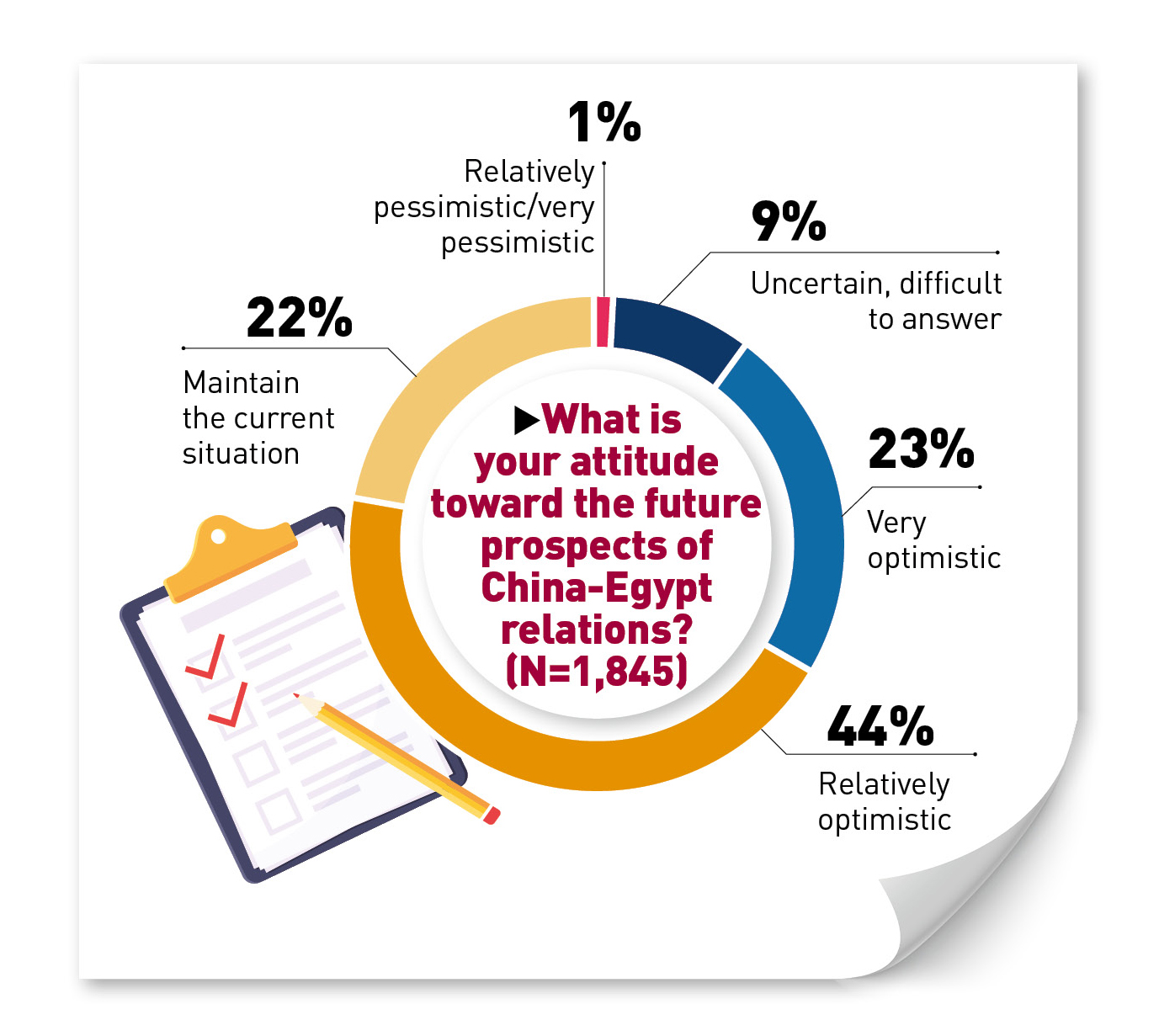
When asked about the future of China-Egypt relations, nearly 70 percent of respondents expressed optimistic expectations, while more than 20 percent believed the relationship would remain unchanged.
Liu Zhongmin, a professor at the Institute of Middle East Studies at Shanghai International Studies University, told the Global Times that Chinese people's favorable impression of Egypt has both historical and contemporary roots.
From a historical perspective, first, then Chinese Premier Zhou Enlai's extensive interactions with then Egyptian leader Gamal Abdel Nasser at the 1955 Bandung Conference helped eliminate misunderstandings among Arab countries about China. This contributed to Egypt becoming the first Arab country to establish diplomatic relations with the People's Republic of China in 1956 and also triggered the first wave of Arab countries to establish diplomatic relations with China. Second, during Egypt's struggle for rights over the Suez Canal, China provided substantial support for Egypt's pursuit of national independence, liberation and interests. Third, during the 1950s and 1960s, China and Egypt jointly opposed imperialism, colonialism and hegemonism, while participating in efforts to promote the rise of the Third World as a new force in international politics. Their historical interactions left a profound impression on both sides, forging a deep friendship between the two countries.
From a contemporary perspective, since the beginning of reform and opening-up, especially since the start of the new era, practical cooperation between China and Egypt in various fields has promoted the development of China-Egypt relations and shaped positive views of Egypt among the Chinese public, Liu said.
Mira Ahmed pointed out that Chinese people's favorable impression of Egypt generally reflects the positive development of China-Egypt relations. The relationship between the two countries is not limited to political and economic fields, but also covers culture, education, tourism and people-to-people exchanges. Most importantly, both sides hold mutual respect and appreciation for each other's civilizations and cultures, laying a solid foundation for the continued development of bilateral relations in the future.
Pragmatic and diversified cooperation Since the beginning of 2026, China and Egypt have signed and implemented a number of industrial parks, and cooperation has accelerated its expansion into new energy. Concrete results have also been achieved in areas such as the automotive industry, finance and currency, urban infrastructure, and cultural heritage and archaeology.
More than 80 percent of respondents have some knowledge of China-Egypt cooperation. Among various cooperation frameworks and projects, more than half of respondents are aware of Egypt's participation in the Belt and Road Initiative, and 32 percent of respondents know about Chinese-built infrastructure projects in Egypt such as light rail and roads. In addition, some respondents are also aware of China-Egypt cooperation in the cultural sphere, such as Confucius Institutes, as well as the production and sales cooperation of Chinese-brand mobile phones, home appliances and automobiles in Egypt.
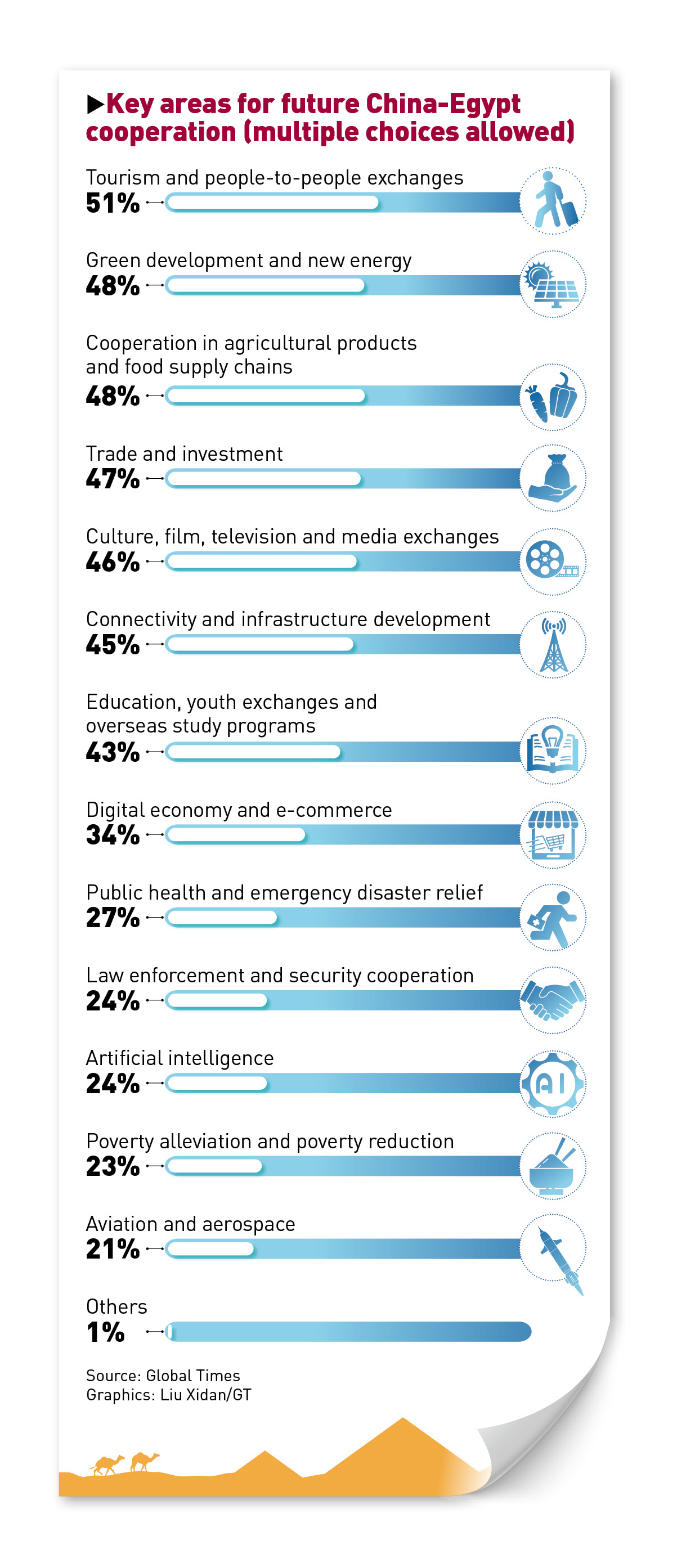
More than 80 percent of respondents believe that, since the establishment of diplomatic relations, cooperation between the two countries has been effective. Moreover, 99 percent of respondents believe that China and Egypt should further deepen cooperation in the future, including in tourism and people-to-people exchanges, green development and new energy, agricultural products, food supply chains, economy and trade, and investment.
More than 90 percent of respondents look forward to advancing cooperation in people-to-people and social exchanges between the two countries in the future. When asked, "If Egypt introduces more convenient Chinese-language services and payment methods for Chinese tourists, would you increase your willingness to travel to Egypt?" more than 70 percent of respondents answered affirmatively. At the same time, more than 70 percent of respondents welcome more Egyptian people to come to China for tourism, study or business activities.
Mira Ahmed said that in recent years, Egypt has taken multiple measures to facilitate Chinese tourists' visits to Egypt, including simplifying visa procedures, developing electronic services, stepping up publicity of Egypt as a Chinese tourist destination and cooperating with Chinese tourism enterprises. Egypt is also working to improve tourism services and infrastructure to provide a safer and more comfortable environment for visitors.
Mira Ahmed believes that the poll results reflect that China-Egypt cooperation has become pragmatic and diversified, transcending purely political or diplomatic relations. "I believe one of the most important features of this cooperation is complementarity. Egypt and China both possess capabilities and expertise that can complement each other, thereby opening up broad prospects for deeper and more sustainable cooperation in the future."
Future cooperation in global governance expectedIn recent years, the international situation has been changing rapidly, with conflicts in the Middle East and prominent problems in global supply chains. As a country in a conflict region, Egypt has actively mediated to help de-escalate the situation. China has actively promoted peace talks and facilitated world peace and development.
More than 90 percent of respondents believe that China and Egypt need to cooperate in the field of global governance in the future. Among them, the largest proportion of respondents (37 percent) look forward to China and Egypt jointly safeguarding the security of shipping in the Red Sea and the Suez Canal. Thirty-five percent of respondents hope that China and Egypt will work together to maintain security and stability in the Middle East and jointly promote the peaceful resolution of the Palestine-Israel issue and the Iran-Israel issue.
Furthermore, 33 percent of respondents hope that China and Egypt will jointly speak up for the Global South on platforms such as BRICS and the UN, and 31 percent of respondents look forward to China and Egypt jointly participating in global poverty reduction in the future.
Liu believes that China and Egypt, both being Global South countries, can cooperate at multiple levels in the field of global governance. First is cooperation between China and the Arab world, particularly within the framework of the China-Arab States Cooperation Forum mechanism, across political, economic, cultural and other fields.
Second, Egypt, the United Arab Emirates and Iran are Global South countries in the Middle East that have joined the BRICS cooperation mechanism in recent years. China and these Middle Eastern countries under the BRICS mechanism all have extensive space for cooperation.
Third, within multilateral mechanisms, including the UN, Egypt is an important partner for China in further solidifying and deepening the implementation of the four global initiatives worldwide. In addition, in the fields of peace, security, development and governance in the Middle East, China and Egypt also have extensive room for cooperation.
China and Egypt should strengthen communication and coordination on hot issues in the Middle East and work to resolve issues related to security and development in the region, Liu said.
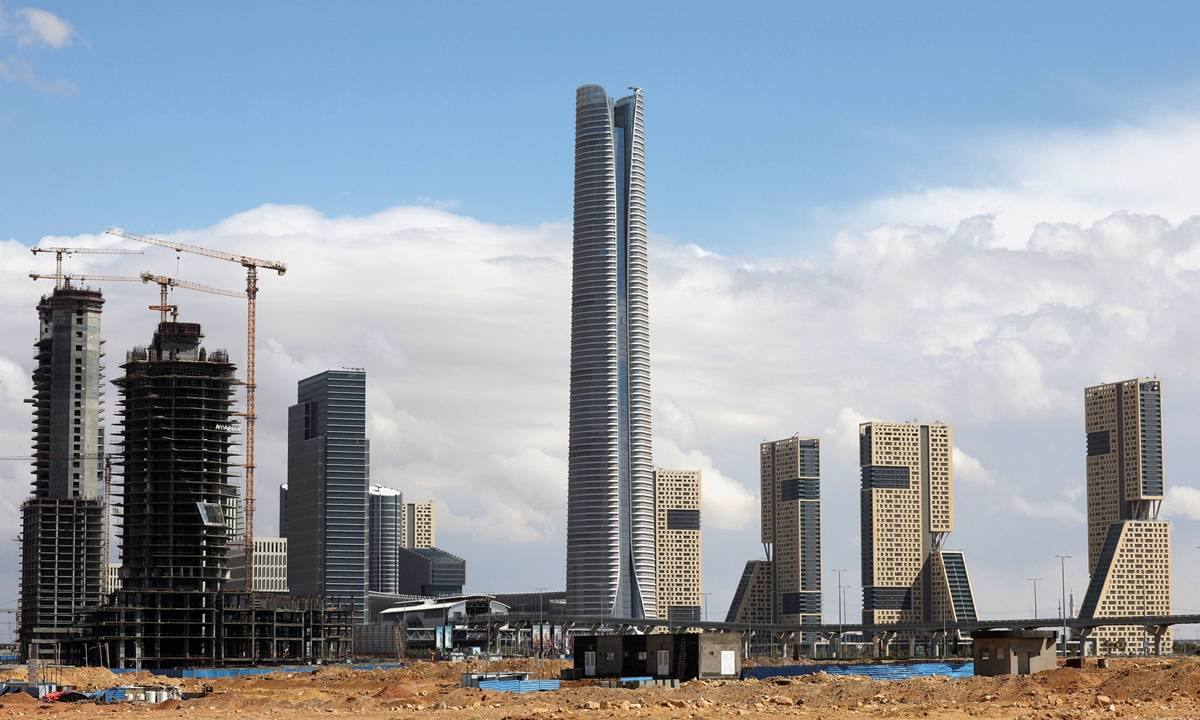 A construction site of the futuristic Iconic Tower, built by a Chinese company, in the Central Business District of Egypt's New Administrative Capital, east of Cairo, on March 25, 2026. Photo: IC
 。

二 |
Current article:http://ln2.cuiguagonggengaotianwan.shop/zfz2v/20260826/8281249.html
Published on:12:30:05

 茅台再次换帅,其中有3个关键点
 一路走好!2025年不到5天四位名人去世,最大的123,最小的才30岁
 名记:看好雷霆新赛季突破60胜 杰威的健康是关键
 韦东奕主编练习册,迫于压力下架?
 India's unicorn startups have doubled since 2021: PM
 苹果诉OpenAI未点名Jony Ive
查看所有0条评论>>